
Boost your reading efficiency with the power of speed reading. In today’s fast-paced world, being able to quickly absorb and process information is crucial for success.
By adopting effective reading techniques, you can significantly improve your reading speed and comprehension. This article will guide you through the process of developing your speed reading skills, helping you to stay ahead in your personal and professional life.
Key Takeaways
- Understand the basics of speed reading and its benefits
- Learn techniques to improve your reading speed and comprehension
- Discover how to apply speed reading in your daily life
- Improve your overall reading efficiency
- Enhance your productivity with effective reading techniques
What Is Speed Reading?
With the vast amount of information available, speed reading has emerged as a valuable technique for managing the deluge of data. Speed reading is not just about reading fast; it’s about reading smart, understanding, and retaining the information you’re reading.
The Science Behind Reading Speed
Reading is a complex process that involves the eyes, brain, and other cognitive functions. Understanding how your brain processes text is crucial to improving your reading speed.
How Your Brain Processes Text
When you read, your eyes don’t move smoothly across the text; instead, they make quick jumps from one point to another, known as saccades. The brain processes the information during the fixations between these saccades. Efficient reading involves minimizing subvocalization, or the habit of pronouncing words in your head as you read.
Average Reading Speeds Explained
The average reading speed for an adult is around 200-300 words per minute (wpm). However, some people can read much faster, up to 600 wpm or more, without compromising comprehension. The key is to find a balance between speed and understanding.
| Reading Speed (wpm) | Comprehension Level | Description |
|---|---|---|
| 200-300 | Average | Typical reading speed for most adults. |
| 300-600 | Above Average | Indicates a good level of reading efficiency. |
| 600+ | High | Skilled readers who can read quickly with good comprehension. |
Benefits of Increasing Your Reading Pace
Increasing your reading pace can have several benefits, including improved productivity and better information processing.
Time Efficiency and Productivity
Faster reading allows you to cover more material in less time, making you more productive. This is particularly beneficial for students and professionals who need to process large amounts of information.
Information Processing Advantages
By reading more efficiently, you can absorb and process information more effectively, leading to better retention and understanding of the material.
As we have seen, speed reading is not just about speed; it’s about improving how you read and understand information. By applying the right techniques, you can significantly enhance your reading efficiency.
Assess Your Current Reading Speed
Understanding your current reading speed is the first step towards improving it. To do this, you need to calculate your words per minute (wpm) and set achievable speed goals.
How to Calculate Words Per Minute
Calculating your wpm is straightforward. You can use a reading speed test to determine your baseline.
Simple Testing Methods
Choose a text, read it for one minute, and count the number of words you’ve read. You can use an online tool or a timer.
Tracking Your Progress
Keep a record of your wpm over time to track your progress. This will help you stay motivated and adjust your goals as needed.
Setting Realistic Speed Goals
Once you know your current reading speed, you can set realistic speed goals. This involves understanding what is achievable for your level.
Beginner Benchmarks
For beginners, a good starting point is to aim for an average reading speed of 200-250 wpm.
Advanced Reader Targets
Advanced readers can aim higher, typically between 400-500 wpm or more, depending on their comfort level and the material.
As
“The more you read, the faster you’ll become.”
Setting realistic goals and tracking your progress is key to improving your reading speed.
Common Obstacles to Reading Quickly
To read quickly and efficiently, it’s essential to identify and overcome certain barriers. Many of us have ingrained reading habits that can slow us down without us even realizing it. Understanding these obstacles is the first step towards improving your reading speed.
Subvocalization: The Silent Speech Habit
Subvocalization is the habit of pronouncing words in your mind as you read. While it might seem harmless, subvocalization can significantly limit your reading speed because it ties your reading pace to your speaking pace. To overcome subvocalization, try to focus on the meaning of phrases rather than individual words.
Regression: The Backtracking Problem
Regression refers to the tendency to re-read material you’ve already covered. This habit not only wastes time but also disrupts your flow, making it harder to maintain a fast reading pace. To combat regression, practice staying focused on the text in front of you and avoid going back unless absolutely necessary.
Limited Peripheral Vision
Limited peripheral vision can restrict your ability to take in groups of words at a glance, forcing you to read word by word. Expanding your peripheral vision allows you to capture more information with each glance, thereby increasing your reading speed. Exercises that focus on widening your field of vision can be particularly helpful.
| Obstacle | Description | Solution |
|---|---|---|
| Subvocalization | Pronouncing words in your mind while reading | Focus on phrases, not individual words |
| Regression | Re-reading material already covered | Stay focused, avoid re-reading unless necessary |
| Limited Peripheral Vision | Reading word by word due to narrow field of vision | Practice exercises to widen your field of vision |
By understanding and addressing these common obstacles, you can significantly improve your reading speed and efficiency. The key is to be aware of your reading habits and be willing to practice new techniques.
Fundamental Speed Reading Techniques
To read faster, it’s essential to learn and practice fundamental speed reading techniques. These techniques are designed to help you read more efficiently and effectively.
The Pointer Method
The pointer method involves using a pointer, such as your finger or a pen, to guide your eyes as you read. This technique helps maintain focus and prevents regression.
Using Your Finger or a Pen
Using your finger or a pen as a pointer is simple and effective. It helps to keep your place and guides your eyes smoothly across the text.
Proper Hand Movement Patterns
To maximize the effectiveness of the pointer method, it’s crucial to use the correct hand movement. Smooth, steady motions are more effective than jerky or erratic movements.
Chunking Words Together
Chunking involves grouping words together to read them as a single unit. This technique can significantly increase your reading speed.
Training Your Eyes to Group Words
Training your eyes to chunk words requires practice. Start by focusing on groups of words rather than individual words.
Phrase Recognition Exercises
Exercises that improve phrase recognition can help you become more comfortable with chunking. Try reading texts that are formatted to group words into meaningful phrases.
Minimizing Subvocalization
Subvocalization, or the habit of silently pronouncing words as you read, can slow you down. Minimizing this habit is crucial for improving reading speed.
Mental Techniques to Reduce Inner Speech
One effective way to reduce subvocalization is to focus on the meaning of the text rather than the individual words. This can help you read more quickly and efficiently.
Practical Drills for Improvement
Drills such as timed reading exercises can help you become more aware of subvocalization and reduce it over time.
| Technique | Description | Benefit |
|---|---|---|
| Pointer Method | Using a finger or pen to guide your eyes | Improves focus and prevents regression |
| Chunking | Grouping words together to read as a unit | Increases reading speed |
| Minimizing Subvocalization | Reducing the habit of silently pronouncing words | Enhances reading efficiency |
How To Speed Read: Advanced Methods
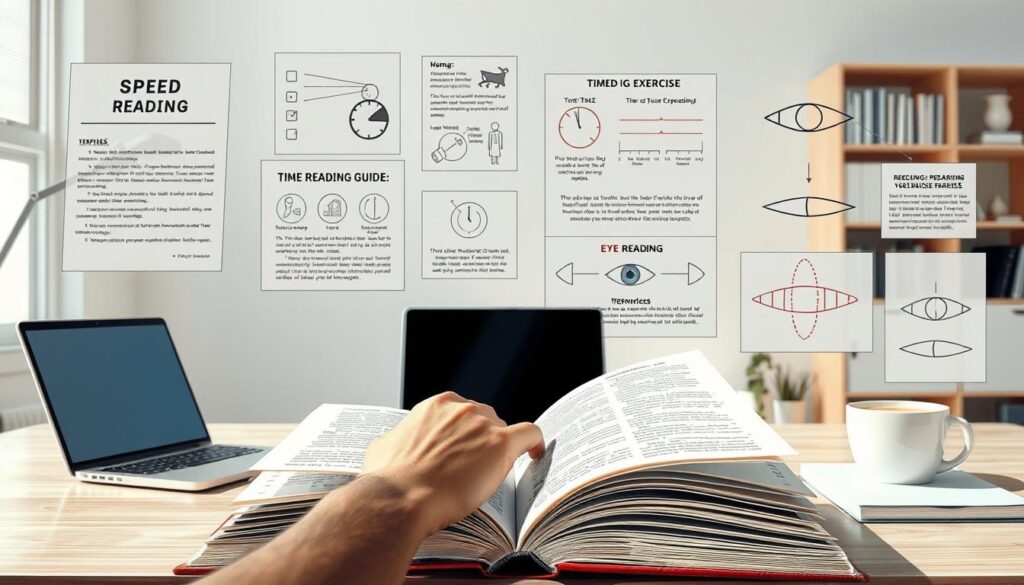
Once you’ve grasped the basics of speed reading, it’s time to explore more sophisticated techniques that can further enhance your reading efficiency and comprehension. Advanced methods such as meta guiding, skimming, and scanning can significantly improve your ability to process information quickly.
The Meta Guiding Technique
The meta guiding technique involves using a visual guide to help your eyes move more smoothly and quickly across the text. This can be achieved by using your finger or a pointer to guide your eyes as you read. By doing so, you can maintain a consistent pace and avoid subvocalization, thereby increasing your reading speed.
Skimming and Scanning Effectively
Skimming and scanning are two essential techniques for quickly understanding the structure and content of a text. Skimming involves glossing over the text to get a general idea of its content, while scanning involves looking for specific information.
When to Skim vs. When to Read Deeply
Knowing when to skim and when to read deeply is crucial for effective reading. Skim when you’re looking for an overview or trying to identify the main ideas. Read deeply when you need to understand complex information or when the material is particularly relevant to your needs.
Identifying Key Information Quickly
To identify key information quickly, focus on headings, subheadings, and bullet points. These elements often contain the main ideas and key details that you need to grasp.
Expanding Your Peripheral Vision
Expanding your peripheral vision is another advanced technique that can improve your reading speed. By training yourself to see more words at a glance, you can reduce the number of eye movements you need to make, thus increasing your reading efficiency. Practice exercises that help broaden your field of vision can be particularly beneficial.
- Practice focusing on the center of a page while still being aware of the text on either side.
- Use flashcards or other training tools to help expand your peripheral vision.
By incorporating these advanced techniques into your reading routine, you can achieve a significant improvement in your reading speed and comprehension.
Balancing Speed and Comprehension
Effective speed reading is not just about reading fast, but also about understanding what you read. As you practice speed reading, it’s crucial to maintain a balance between your reading speed and comprehension.
Active Reading Strategies
Active reading involves engaging with the material you’re reading, rather than just passively scanning the text. This can be achieved through several strategies.
Pre-Reading Preparation
Before you start reading, take a moment to prepare. This can involve skimming the headings, understanding the structure of the text, and identifying the main topics covered. Pre-reading preparation helps you focus your reading and retain more information.
Maintaining Focus While Reading Fast
To maintain focus, eliminate distractions, and use techniques like the pointer method to guide your eyes. Staying engaged with the material is key to maintaining comprehension while reading quickly.
Retention Techniques
Retaining information is just as important as reading quickly. Several techniques can help improve retention.
Note-Taking Methods for Speed Readers
Even when reading quickly, taking notes can significantly improve retention. Use abbreviations and symbols to keep up with your reading speed. Reviewing your notes after reading can also help solidify the information in your memory.
Memory Aids and Visualization
Using visualization techniques can help you remember complex information. Associate new information with mental images or memories to enhance retention. Creating a mental map of the information can make it easier to recall later.
| Technique | Description | Benefit |
|---|---|---|
| Pre-reading | Skim headings and understand the text structure | Improved focus and retention |
| Pointer Method | Use a pointer to guide your eyes | Maintains focus and increases reading speed |
| Visualization | Associate information with mental images | Enhanced memory retention |
Applying Speed Reading to Different Materials
To get the most out of speed reading, it’s essential to understand how to adjust techniques for different types of content. The versatility of speed reading lies in its ability to be adapted to various materials, enhancing both comprehension and reading speed.
Academic and Technical Texts
When dealing with academic and technical texts, the focus should be on identifying key terms, concepts, and the structure of the argument or explanation. Techniques such as chunking and meta guiding can be particularly effective. These texts often contain dense information, so it’s crucial to slow down enough to grasp complex ideas.
Fiction and Narrative Works
Fiction and narrative works require a different approach. Here, the focus is on character development, plot progression, and the author’s style. Speed reading can be applied by skimming less important sections and focusing on dialogue and key events. However, readers should be cautious not to miss crucial plot points or character insights.
Digital Content and Online Reading
Digital content and online reading present unique challenges, such as distractions from ads or hyperlinks. To effectively speed read digital content, it’s helpful to use tools like browser extensions that remove distractions or apps that help you stay focused. Skimming and scanning are particularly useful in this context, allowing readers to quickly identify relevant information.
As stated by
“The more you read, the more you know, and the more you know, the faster you can read.”
This quote emphasizes the importance of practice in improving reading speed and comprehension across different materials.
By adapting speed reading techniques to the type of material, readers can significantly enhance their reading efficiency and comprehension. Whether reading academic texts, fiction, or digital content, the key is to stay flexible and adjust your approach as needed.
Practical Exercises to Improve Reading Speed
The key to enhancing your reading speed lies in daily practice and specialized exercises. Consistent practice helps in developing the skills necessary for speed reading, making it a habit over time. In this section, we will explore practical exercises that can help you improve your reading speed effectively.
Daily Practice Routines
Establishing a daily practice routine is crucial for improving your reading speed. Here are some exercises you can incorporate into your daily schedule:
5-Minute Speed Drills
Start with a simple exercise where you read a text for 5 minutes as fast as you can. Record your words per minute (WPM) and gradually increase your speed over time. This drill helps in building your reading endurance and increasing your reading pace.
Progressive Training Schedule
Create a progressive training schedule where you gradually increase the difficulty level of your reading material or the duration of your reading sessions. For example, start with easy texts and gradually move to more complex materials.
| Day | Reading Material | Duration |
|---|---|---|
| Monday | Easy Article | 5 minutes |
| Wednesday | Moderate Text | 7 minutes |
| Friday | Complex Material | 10 minutes |
Specialized Exercises for Problem Areas
Identify areas that hinder your reading speed, such as regression habits or limited peripheral vision, and practice specialized exercises to overcome them.
Fixing Regression Habits
To fix regression habits, practice reading a text while using a pointer to guide your eyes. This technique helps in maintaining focus and reducing the tendency to backtrack.
Expanding Visual Field Exercises
Practice expanding your visual field by focusing on the center of a page and trying to capture the surrounding text without moving your eyes. This exercise enhances your peripheral vision, allowing you to read more words at a glance.

Conclusion: Making Speed Reading a Lifelong Skill
Developing a lifelong skill in speed reading requires consistent practice and dedication. By incorporating the techniques outlined in this article into your daily routine, you can achieve significant reading improvement over time.
Regular speed reading practice helps to reinforce new habits and expand your reading capabilities. As you continue to challenge yourself, you’ll notice improvements not only in your reading speed but also in your comprehension and retention.
Making speed reading a lifelong skill is a journey, not a destination. With persistence and the right strategies, you can unlock a world of knowledge and enjoy a more efficient reading experience. Stay committed, and you’ll be amazed at the progress you can make.