
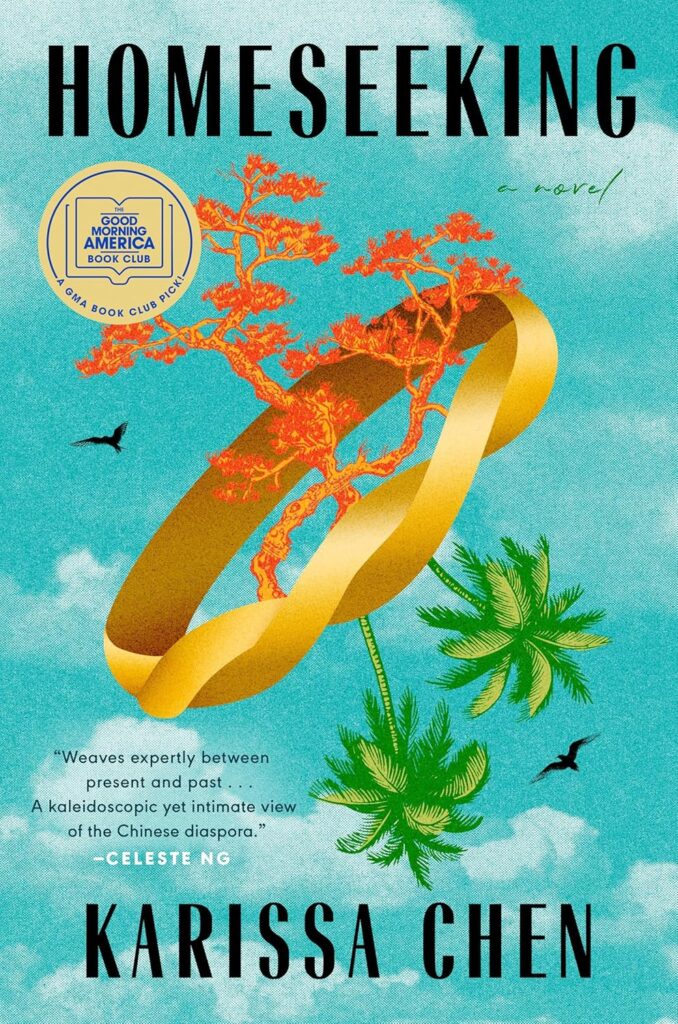
In the dim, violet haze of a Shanghai dawn, where the nightsoil man’s cart rumbles and a porridge peddler’s song cuts through the longtang’s waking hum, Karissa Chen’s Homeseeking (G.P. Putnam’s Sons, 2025) begins with a gut-punch of longing. This debut novel, sprawling across six decades and four nations, isn’t just a love story—it’s a bone-deep excavation of what home means when war, exile, and time rip it away. Chen, a Taiwanese American writer, crafts a tale of two childhood sweethearts, Suchi and Haiwen, whose lives are torn apart by the Chinese Civil War and the tides of history. Their chance reunion in a Los Angeles grocery store in 2008, after sixty years, is the spark that ignites this epic, a saga that’s as intimate as a whispered promise and as vast as the diaspora it traces. For readers of historical fiction, Homeseeking is a must-read, blending the personal with the political in a way that’ll leave you staring at the wall, wondering about the ghosts of your own past. Explore our guide to the best historical fiction of 2025 for more epic tales.
Outline
- Plot Summary (No Spoilers): A look at the novel’s sweeping narrative and historical backdrop.
- Character Development: How Suchi and Haiwen evolve through love, loss, and survival.
- Major Themes: Exploring home, identity, sacrifice, and memory.
- Pros and Cons: What shines and what stumbles in Chen’s debut.
- Who Would Enjoy This Book: The ideal audience for Homeseeking.
- Similar Books: Comparable reads to keep you immersed in the diaspora experience.
- About the Author: Karissa Chen’s background and influences.
- Final Thoughts: Why this novel lingers and where it fits in 2025’s literary landscape.
Plot Summary (No Spoilers)
Homeseeking opens in 1947 Shanghai, where the air is thick with the chaos of civil war. Suchi, a girl of seven when we first meet her, is drawn to Haiwen, her neighbor, whose violin melodies drift through their shared longtang. Their bond, forged in the innocence of childhood, deepens into a love that feels fated—until Haiwen, driven by familial duty, enlists in the Nationalist army, leaving Suchi with only a note and his violin. From here, Chen weaves a dual timeline: Haiwen’s story unfolds backward from 2008 Los Angeles, where he’s a widowed old man buying bananas at a 99 Ranch Market, to his youth in Shanghai. Suchi’s narrative moves forward, from her childhood to the present, tracing her path through Hong Kong’s song halls, New York’s bustling streets, and California’s sunny sprawl. The novel spans the Chinese Civil War, the Cultural Revolution, and the immigrant experience, never shying away from the raw cost of displacement. Chen’s prose, described by the San Francisco Chronicle as “wonderfully cinematic,” paints each setting with vivid detail, from the “trundle of the nightsoil man’s cart” to the neon glow of Hong Kong. Dive into our article on the Chinese diaspora in literature for context.
Character Development
Suchi and Haiwen are the beating heart of Homeseeking, their arcs shaped by the relentless churn of history. Suchi starts as a wide-eyed girl, her dreams tied to Haiwen and their Shanghai neighborhood. Her journey—marked by her father’s bookstore, a desperate marriage, and eventual migration to Hong Kong and beyond—hardens her into a woman who survives by looking forward, refusing to dwell on the past. Chen writes, “Suchi knew now that home wasn’t a place… It was people who shared the same ghosts as you” (Homeseeking). Her pragmatism, born of betrayal and loss, makes her both relatable and heartbreakingly distant. Haiwen, meanwhile, is a dreamer, his violin a symbol of the life he might’ve had. His enlistment to save his brother from the draft sets off a chain of sacrifices, from Taiwan’s military camps to a new identity as Howard in America. His reflective nature, captured in lines like “How he longed to live a synthesis of all the lives he had lived and not lived,” reveals a man haunted by what-ifs. Chen’s use of multiple names for each character—reflecting linguistic shifts across Mandarin, Shanghainese, and English—mirrors their fractured identities, a nod to the diaspora’s fluidity. Supporting characters, like Suchi’s idealistic father or Haiwen’s Anglophile parents, add depth but sometimes feel underexplored, as the New York Times notes, with their stories often summarized in dialogue rather than shown.
Graph: Character Arc Progression
- Suchi: Starts as hopeful child (1945), peaks in resilience during Hong Kong years (1950s), stabilizes as guarded matriarch in LA (2008).
- Haiwen: Begins reflective in old age (2008), regresses to idealistic youth in Shanghai (1940s), with pivotal shift at enlistment (1947).
Major Themes
Homeseeking wrestles with themes that cut to the bone, each woven into the fabric of Suchi and Haiwen’s lives:
- Home and Displacement: The novel redefines home not as a fixed place but as “people who share the same ghosts as you” (Homeseeking). Suchi’s journey from Shanghai to Hong Kong and America reflects the immigrant’s “phantom limb,” a longing for a lost homeland, as The Washington Post eloquently describes. Read our piece on immigrant narratives in fiction.
- Love and Sacrifice: The lovers’ separation, sparked by Haiwen’s enlistment, underscores how love endures through impossible choices. Their “mingyun” (personal destiny) shapes their paths, as a fortune teller predicts in 1945, blending fate and agency.
- Identity and Adaptation: Multiple names for Suchi and Haiwen reflect their shifting identities across cultures and languages, a point Chen explains in her author’s note as a nod to diaspora realities. BookPage praises her “effortless navigation across cultures.”
- Memory vs. Progress: Haiwen clings to memories, while Suchi forces herself forward, creating tension when they reunite. This dynamic, per Harper’s Bazaar, explores “the enduring power of finding your home.”
- War’s Lasting Impact: The Chinese Civil War and Cultural Revolution ripple through their lives, shaping their traumas and choices. Chen’s research, inspired by her grandfather’s exile, grounds these effects in vivid detail, as noted in an interview on kathleenhaagenson.com.
Pros and Cons
Pros
- Lush Prose: Chen’s writing, lauded by Good Housekeeping as “sweeping and epic,” paints Shanghai’s longtangs and Taiwan’s camps with visceral clarity.
- Emotional Depth: The novel’s ability to balance intimate love with historical upheaval makes it a “heartwarming and devastating page-turner,” per USA Today.
- Innovative Structure: Alternating timelines (Haiwen backward, Suchi forward) create a “refreshing” narrative, as Book Club Chat notes, converging powerfully in 2008.
- Cultural Authenticity: Chen’s inclusion of linguistic shifts and historical details, like the Kowloon-Canton railway, adds richness, though some inaccuracies (e.g., Shanghai’s International Settlement) are noted by Asian Review of Books.
Cons
- Pacing Issues: The New York Times critiques occasional lags, especially when political context overshadows character moments.
- Underdeveloped Subplots: Family stories, like Suchi’s father’s disillusionment or Haiwen’s parents’ vilification, are often summarized rather than fully explored, reducing emotional weight.
- Expositional Dialogue: Barnes & Noble points out Chen’s reliance on dialogue to convey historical nuances, which can feel heavy-handed.
- Complex Timeline: Some readers, per Goodreads, found the nonlinear structure disorienting, though it serves the story’s themes.
Who Would Enjoy This Book
Homeseeking is a slam-dunk for fans of historical fiction who crave emotional depth and cultural nuance. Readers of Amy Tan’s The Joy Luck Club or Min Jin Lee’s Pachinko will devour its multigenerational saga and diaspora focus. Check our review of Pachinko for similar vibes. It’s perfect for book clubs—Book Club Chat offers discussion questions on its themes of home and sacrifice—and those drawn to epic romances or immigrant stories. If you’re into introspective narratives about love enduring through war, or if you’ve ever wrestled with the ache of a lost homeland, this book will hit hard. It’s less suited for readers who prefer fast-paced plots or shy away from nonlinear timelines.
Similar Books
- The Joy Luck Club by Amy Tan: Like Homeseeking, it explores Chinese American identity and family across generations. Read our Joy Luck Club review.
- Pachinko by Min Jin Lee: A multigenerational epic of Korean immigrants in Japan, sharing Chen’s focus on displacement and resilience.
- Real Americans by Rachel Khong: A contemporary take on Chinese American identity and family secrets, ideal for Homeseeking fans. See our Real Americans discussion.
- The Leavers by Lisa Ko: Another diaspora story, focusing on a Chinese immigrant’s search for belonging, praised by Penguin Random House alongside Homeseeking.
- Half a Lifelong Romance by Eileen Chang: Chen’s epigraph from this classic Shanghai love story signals its influence, per Asian Review of Books.
About the Author
Karissa Chen, a Taiwanese American writer, brings a personal lens to Homeseeking, inspired by her grandfather’s exile from China after 1949, as she shared in an interview on kathleenhaagenson.com. A Fulbright fellow and Kundiman Fiction fellow, her work has appeared in The Atlantic, Longreads, Guernica, and The Cut. She serves as editor-in-chief of Hyphen magazine and holds an MFA from Sarah Lawrence College. Chen’s residencies at Millay Arts and the Virginia Center for the Creative Arts honed her craft, and her storytelling reflects a deep engagement with Chinese history and diaspora identity. Splitting her time between New Jersey and Taipei, she’s lauded as “a writer to watch” by Booklist.
Final Thoughts
Homeseeking is a stunner, a novel that’ll break your heart and stitch it back together. Chen’s debut, hailed by Pittsburgh Post-Gazette as “one of the best of this century,” balances the epic and the intimate with grace. Its flaws—occasional pacing hiccups and underexplored subplots—don’t dim its shine. For readers seeking a story that wrestles with love, loss, and the search for home, this is a top pick for 2025. Explore our top debut novels of 2025 for more. Pick it up, let it linger, and brace for tears.
Book Details