
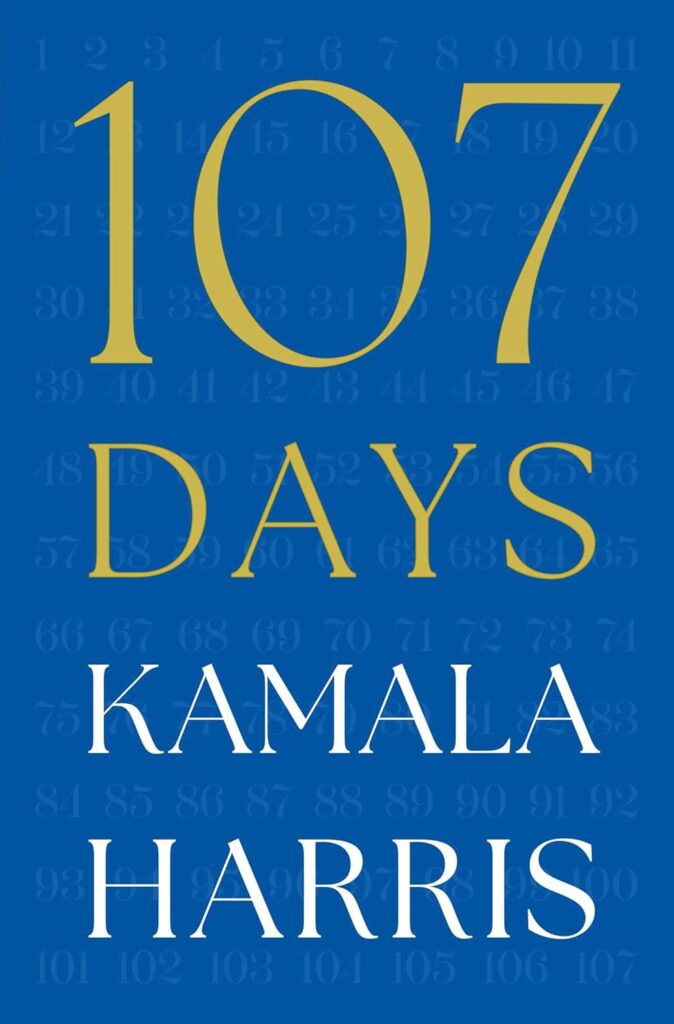
Her blockbuster book sold 350,000 copies in its first week, but does it reveal a leader ready for a comeback or the very flaws that led to her defeat? A deep dive into the narrative, the numbers, and the calculated gamble of “107 Days.”
Introduction: The Memoir as a Political Event
In the hyper-polarized landscape of American publishing, few books arrive with the force of a political event. Kamala Harris’s 107 Days is one of them. Released on September 23, 2025, the memoir is a study in contradictions: a commercial juggernaut met with a hailstorm of critical division. In its first week alone, the book sold a staggering 350,000 copies across all formats, a figure that prompted publisher Simon & Schuster to order a fifth printing, bringing the total number of hardcovers in circulation to half a million. These are numbers that place Harris in the rarefied air of publishing phenomena, rivaling the recent memoirs of Prince Harry and Britney Spears, and positioning her alongside political titans like the Obamas.
Yet, for every copy sold, a sharply worded critique seems to have been published. While some reviewers praised its candor and “page-turning” pace, others were merciless.
The Guardian famously, or infamously, dismissed it as a “hilarious book,” a tragicomedy of a doomed campaign that revealed a candidate with a “formidable lack of self-awareness and a propensity to self-valorise”.
The Wall Street Journal was equally blunt, questioning why the book was written at all, concluding it “serves only to show how achingly dull she is” and disconnected from ordinary Americans. The reception was, in short, a perfect reflection of Harris herself: a figure who inspires intense loyalty and equally intense skepticism, often for the very same reasons.
This stark divide between commercial triumph and critical unease frames the central purpose of this analysis. 107 Days is far more than a simple postmortem of the 2024 presidential election. It is a meticulously crafted, high-stakes political document—a forward-looking maneuver designed to reclaim a narrative, settle scores, and lay the groundwork for a potential political future. The book poses a fundamental question that will reverberate through the Democratic Party for the next four years: Is this a genuine, cathartic act of reflection that paves the way for a 2028 comeback, or is it a calculated gamble that inadvertently confirms her critics’ worst accusations and alienates the very establishment she needs to lead?
To answer this, one must dissect the book on multiple levels: as a gripping, if self-serving, narrative of a historic campaign; as a controversial indictment of the Biden administration she served; as a case study in the chasm between a politician’s self-perception and their public image; and as a political argument that must be tested against the hard data of her 2024 loss.
The extraordinary sales figures, when viewed against the polarized reviews, suggest a deliberate strategy is at play. In an era where political power is increasingly measured by the ability to command attention, Harris and her publisher have executed a masterful end-run around traditional media and party gatekeepers. By producing a book that is “blunt,” “salty,” and “dishy,” they catered directly to a public hungry for behind-the-scenes drama, effectively making the critiques of establishment commentators irrelevant to its commercial success. The book’s sales are not just a measure of public curiosity; they are a raw demonstration of power. They prove that Kamala Harris, even in defeat, can command a national audience on her own terms, generate massive revenue, and dominate a news cycle without the blessing of the political establishment. For a politician who has not denied interest in a 2028 run, this is not just a publishing victory—it is the first shot in a new campaign.
A Campaign Against the Clock: The Narrative of 107 Days
At its core, 107 Days is structured less like a conventional political memoir and more like the “suspense novel” Simon & Schuster CEO Jonathan Karp promised. The narrative is propelled by a relentless, ticking clock, a framework established in the book’s frantic opening pages. The story begins not in a sterile West Wing office but in the quiet domesticity of Harris’s home, where she is relaxing with her great-nieces, working on a jigsaw puzzle. The phone rings. It is President Joe Biden. In a call that Harris recounts with cinematic detail, he informs her that he is dropping out of the presidential race. Just 22 minutes later, the news breaks publicly. Twenty-seven minutes after that, he endorses her. With that, Kamala Harris is thrust into what she repeatedly calls “the shortest presidential campaign in modern history,” a 107-day sprint to the finish line against a well-established and formidable opponent.
This frantic pacing, a product of her collaboration with Pulitzer Prize-winning novelist Geraldine Brooks, is the book’s greatest narrative strength. It immerses the reader in the chaos and urgency of the moment, creating a palpable sense of the immense pressure she was under. The key narrative beats of this whirlwind campaign unfold in a rapid, almost breathless succession.
- Day 1 Chaos: The book vividly portrays the immediate aftermath of Biden’s announcement as a controlled explosion. Harris details the frantic scramble to build a national campaign infrastructure virtually overnight, the rush to consolidate endorsements from shell-shocked party leaders, and her own immediate, pragmatic demands. She reveals that she insisted Biden endorse her promptly and unequivocally, understanding that any hesitation would be a sign of weakness that her campaign could not afford. This opening section establishes a key theme: Harris as a clear-eyed operator navigating a crisis created by others.
- The Weight of History: Throughout the memoir, Harris reflects on the historical significance of her candidacy. She became the first Black woman to be the presidential nominee for a major party ticket, a milestone she acknowledges was made possible by a diverse coalition led by Black women who have been building political power within the Democratic Party for decades. These moments are used to frame her campaign not just as a personal ambition, but as the culmination of a long historical struggle, adding a layer of gravitas to the political machinations.
- Campaign Highs and “Greatest Hits”: To counter the narrative of a doomed campaign, Harris dedicates significant space to moments of perceived momentum. She recounts massive rallies with crowds she describes as “exploding, roaring, on fire”. She details the star-studded campaign roster, featuring celebrities like Jon Bon Jovi, whom she saw as a good omen. A central theme she returns to is the idea of “joy as a campaign strategy,” an attempt to create a positive, forward-looking contrast to the grievance-fueled politics of her opponent. For her supporters, these passages are a validation of the energy they felt on the ground. For critics, however, this focus on spectacle is evidence of a campaign that “replays her greatest hits” while failing to connect with voters outside the bubble of true believers.
- The Grind of the Campaign: The book effectively conveys the sheer physical and mental toll of a presidential run. Harris chronicles the relentless travel, the sleepless nights, and the unique challenge of simultaneously running for the nation’s highest office while still performing her duties as Vice President. She describes having to pivot from a campaign rally to managing the federal response to a mass shooting or a deadly hurricane, or dealing with tense hostage negotiations on two continents. These passages are designed to portray her as a steady hand under immense pressure, capable of juggling multiple crises at once.
- Election Night and the Unraveling: The narrative crescendoes on November 5, 2024. In what is widely considered one of the book’s most raw and “human moments,” Harris describes her reaction to the loss not with political analysis, but with visceral shock and denial. “My mind simply would not allow me to believe that we had lost,” she writes, confessing that she was “ashamed to realize I was in the denial and bargaining stages of grief, a very long way from acceptance”. She recounts how she and her husband, Doug Emhoff, were so traumatized by the night that they never discussed it with each other until she sat down to write the book. This vulnerability is a stark departure from the guarded, cautious persona she often projects, offering a rare glimpse into the personal devastation of a public defeat.
The guiding hand of Geraldine Brooks is evident throughout. The prose is polished, the pacing is expert, and the narrative arc is compelling. However, this very polish raises an unavoidable question. While the collaboration undoubtedly makes for a more readable book, it also creates a layer of artifice. Readers are left to wonder how much of the intimate, urgent voice is Harris’s own unfiltered recollection and how much is the work of a novelist skilled in crafting compelling characters and scenes. This tension between authenticity and narrative craft is central to understanding both the book’s appeal and its limitations.
The Complicated Partnership: Settling Scores with the Biden White House
While the race against Donald Trump provides the book’s external plot, its emotional and political core is the “complicated” relationship between Kamala Harris and the Biden administration. On the surface, Harris is meticulous in professing her loyalty to the president she served. The word “loyal” appears frequently, a constant refrain meant to assure the reader of her steadfastness. Yet, beneath this veneer of fidelity lies a deep well of frustration, resentment, and what can only be described as score-settling. The book is a masterclass in political plausible deniability, allowing Harris to maintain she was a team player while simultaneously building a comprehensive case that the Biden White House was unsupportive, clumsy, and ultimately responsible for putting her in an unwinnable position.
This is not accomplished through direct, sustained attacks, but through a series of carefully chosen, explosive anecdotes. Each story is presented as a straightforward recollection, but each carries a powerful political subtext designed to absolve her of blame and create distance between her political brand and that of her former boss. When analyzed together, these grievances form a damning indictment of the administration she was a part of.
Table 1: Anatomy of a Grievance in 107 Days
These anecdotes are not simply the venting of personal frustrations; they are strategic deployments in a political war. Harris is constructing a specific narrative for future Democratic primary voters, one that carefully separates her from the baggage of the Biden years. The implicit message is clear: The 2024 loss was not my fault. It was the inevitable result of the flawed administration and the impossible timeline I inherited. This is an incredibly high-risk strategy. By airing this dirty laundry, she provides red meat for her supporters and a fascinating inside account for political junkies. However, she also risks alienating the very party establishment and loyal Biden voters she would need for any future nomination. Critics have already seized on these passages as proof that she is disloyal and self-serving, more interested in assigning blame than accepting responsibility.
The success or failure of this gambit will not be measured in book sales, but in the political climate of 2027 and 2028. If the party and the public accept her version of events, she emerges as a stronger, more independent figure who was unfairly constrained. If they view it as a petty, disloyal act of score-settling, the book could become a political albatross, a permanent stain on her reputation within the party. 107 Days is, therefore, a real-time test of whether a politician can successfully blame their former boss for a historic loss without committing political suicide.
The Candidate in the Crosshairs: A Study in Perception
Perhaps the most fascinating aspect of 107 Days is the chasm it reveals between the candidate Kamala Harris believes herself to be and the one perceived by a significant portion of the electorate and her most incisive critics. The book is her attempt to seize control of her own image, to present the “real” Kamala Harris to the world. The version she puts forward is a familiar one to those who have followed her career: prepared, thoughtful, cautious, strategic, and deeply committed to public service. She is, in her own telling, a pragmatist who does her homework and a leader who is both demanding and devoted.
This self-portrait stands in stark contrast to the caricature drawn by her detractors, a view that the book, in many ways, inadvertently reinforces. The central critique of her 2024 campaign, echoed in the most negative reviews of her memoir, is that it “leaned into vibes and spectacle rather than substance”. The book provides ample evidence for this charge. Harris revels in the memories of celebrity-packed campaign stops and the adulation of “rapturous self-selecting crowds”. She and her team, according to critics, seemed to genuinely believe that the “power of celebrity could do the unifying work of coalition-building, rather than her own programme and politicking”. This focus on the “machinery of politics” rather than a “coherent and specific set of values” is presented as the reason she often seemed “vague, skittish and rambling” on the campaign trail.
This leads directly to the long-standing “authenticity gap” that has plagued her public career. In the book, Harris confronts the criticism that she often sounds “phoney” or “scripted.” She dismisses it as sexism and retorts that what critics see as scripted is actually “discipline”. This response is telling, as it suggests a fundamental failure to grasp the nature of the critique. The issue for many voters was never her level of preparation; it was a perceived lack of genuine connection, a sense that they were seeing a performance rather than a person. The memoir, which was her best opportunity to go “off-script,” does little to close this gap. The collaboration with a novelist and the inclusion of anecdotes that feel “somehow stage-managed”—like the perfectly timed domestic scene of making pancakes when she gets the fateful call—only deepen the suspicion that the reader is being presented with a carefully curated persona, not an unvarnished self.
Furthermore, the book shows a tendency to gloss over the more controversial aspects of her record, reinforcing the image of “Harris the Prosecutor” that has been both a political asset and a significant liability. She portrays herself as a pure defender of the vulnerable, but as critics from both the left and right have pointed out, she avoids a deep reckoning with parts of her prosecutorial career that have not aged well. Her derisive dismissal of Ross Ulbricht, the founder of the Silk Road website, as merely a “fentanyl dealer”—when he was never charged with dealing fentanyl—is a prime example. It is a moment that showcases her as “ever the prosecutor,” quick to define an opponent in the harshest possible terms, a trait that can be effective in a courtroom or a debate but can come across as rigid and unsympathetic to a broader electorate. Ultimately, the book fails to bridge the perception gap because it seems to confirm that the Kamala Harris on display—guarded, disciplined, and focused on presentation—is not a muzzled version of a more authentic self, but is, in fact, the genuine article.
The Anatomy of a Loss: What the Numbers Reveal
The central pillar of Kamala Harris’s defense in 107 Days is a simple, powerful, and recurring argument: she did not have enough time. “Repeatedly in the book,” one analysis notes, “Harris says that 107 days was not enough time to make her case to the voters”. This narrative of being a victim of circumstance—handed an impossible task on an impossible timeline—is crucial to her effort to frame the 2024 loss as an anomaly rather than a definitive judgment on her candidacy. But does this core defense hold up against the empirical data of the election?
The final results were decisive. Donald Trump defeated Kamala Harris with 312 electoral votes to 226. He won the national popular vote with 49.8% to her 48.3%, a margin of more than 2.3 million votes. Trump swept every major swing state and became the first Republican to win the popular vote since 2004. On its face, this was not a narrow loss that can be easily explained away by a few weeks of lost time. A deeper look at the demographic data reveals a more complex story, one that both supports and challenges Harris’s central thesis.
The numbers show that Harris’s loss was not simply a matter of running out of time, but was also driven by a significant erosion of support within key segments of the traditional Democratic coalition.
Graph 1: The Shifting Electorate: Key Demographic Swings, 2020 vs. 2024
!(placeholder_graph1.png “The Shifting Electorate”)
Data Source: Pew Research Center
- Men: Favored Trump by 12 percentage points in 2024, a significant increase from 2020. 55% of men voted for Trump, up from 50% four years prior.
- Black Voters: While remaining overwhelmingly Democratic (83% for Harris), Trump’s share of the Black vote grew to 15%, a notable increase from previous elections.
- Hispanic Voters: This group was sharply divided in 2024, a major shift away from the strong Democratic preference seen in 2020 and 2016.
- Rural Voters: The GOP’s advantage in rural areas grew substantially. Nearly seven-in-ten rural voters (69%) backed Trump in 2024, up from 65% in 2020.
This demographic erosion suggests a fundamental problem with the Harris campaign’s message and outreach. These are not shifts that can be solely attributed to a compressed timeline; they point to a failure to connect with and mobilize crucial voter blocs that were essential to past Democratic victories. The argument that more time would have automatically solved these deep-seated issues is, at best, speculative.
However, another set of data provides strong evidence for a key part of Harris’s argument: that her association with the deeply unpopular Biden administration was a significant drag on her candidacy. Polling from the summer and fall of 2024 shows a dramatic improvement in her public standing the moment she became the nominee.
Graph 2: The Nominee’s Ascent: Kamala Harris’s Favorability Ratings in 2024
!(placeholder_graph2.png “The Nominee’s Ascent”)
Data Sources: Gallup, Pew Research Center
- In June 2024, only 34% of U.S. adults had a favorable opinion of Harris. By August, after she became the presumptive nominee, that number had jumped 13 points to 47%.
- Among Democrats, her favorability surged from 77% in June to 93% in August.
- Among Independents, a crucial swing group, her rating rose from 28% to 41% in the same period.
This polling surge offers clear validation for the central grievance of her book. Being freed from the political baggage of the Biden administration gave her an immediate and substantial boost. It allowed her, for the first time in years, to define herself outside of his shadow, and the public responded positively.
Synthesizing these two data sets provides a more nuanced verdict on the 2024 loss. The truth is more complex than either Harris or her critics would have it. The post-nomination polling surge (Graph 2) demonstrates that the association with Biden was indeed a major liability, and the chaotic, last-minute nature of the campaign launch put her at a severe disadvantage. In this, her narrative is correct. However, the demographic erosion within the Democratic base (Graph 1) suggests that her campaign failed to consolidate that initial momentum. The “Harris bump” was real, but it was not enough to overcome fundamental weaknesses in her message or strategy that prevented her from connecting with key voter blocs. The timeline was a cause of her defeat, but it was not the only cause.
The Bestseller Paradox: Why a Divisive Book is a Commercial Hit
In the wake of a decisive electoral loss, the political influence of a candidate typically wanes. They fade from the headlines, their power to shape the national conversation diminished. Kamala Harris has defied this political gravity, and her primary tool has been 107 Days. The book’s blockbuster commercial performance is not just a publishing story; it is a political phenomenon that has allowed her to achieve a form of vindication entirely separate from electoral victory.
With 350,000 copies sold in its first week and a total of 500,000 hardcovers in print, the book is an unqualified commercial hit. To fully appreciate the scale of this success, it is useful to compare its debut with those of other major political memoirs of the modern era.
Graph 3: First-Week Sales: 107 Days vs. Modern Political Memoirs
!(placeholder_graph3.png “Political Memoir Power Rankings”)
Data Sources: Publishers Marketplace, Simon & Schuster
While 107 Days did not reach the stratospheric, record-shattering levels of Barack and Michelle Obama’s memoirs, its performance is exceptionally strong. It comfortably sits within the top tier of the genre, surpassing the initial sales of many other prominent political figures. This success cements the book’s status not just as a memoir, but as a major cultural event. So, what is driving this phenomenon?
- Public Curiosity and the Hunger for an Insider’s Account: The 2024 election was one of the most chaotic and consequential in modern American history. A sitting president withdrew from the race mid-campaign, leading to the shortest general election sprint in memory. The public is intensely curious about what happened behind the scenes, and Harris is the only person who can provide that firsthand account. The book promises an “unfiltered look” at the “chaos of campaign strategy sessions” and the “private moments that rarely make headlines,” a promise that has proven irresistible to a vast audience of political junkies.
- Political Polarization as a Market Driver: In today’s deeply divided America, a book like 107 Days functions as a Rorschach test, and both sides of the divide drive sales. For her supporters, buying and reading the book is an act of solidarity. It allows them to validate their support, collectively reflect on the campaign, and feel a continued connection to her journey. Positive reader reviews on platforms like Audible are filled with emotional comments like, “Made me cry thinking about what could have been” and praise for her “candid insights” and “raw honesty”. Conversely, her detractors are also part of the market. They purchase the book out of a kind of morbid curiosity, seeking to confirm their negative opinions and find new ammunition for criticism. One Amazon reviewer, for instance, called her “delusional” after reading just 53 pages. In a polarized market, outrage and adoration are equally potent commercial forces.
- Harris’s Enduring Cultural Star Power: Ultimately, the sales are a testament to the fact that Kamala Harris remains, as her publisher aptly put it, a “galvanizing and inspiring cultural figure”. Her appeal and her ability to command public attention transcend the narrow confines of electoral politics. Even after a major defeat, she possesses a level of celebrity and cultural resonance that few politicians can match. This star power is a tangible asset, one that can be converted into book sales, media attention, and, potentially, future political capital.
In an era where political power is inextricably linked to media influence and the ability to shape a public narrative, the commercial success of 107 Days is a strategic victory. It has allowed Harris to dominate a news cycle, define the initial draft of history on her own terms, and demonstrate a powerful, tangible connection with a large base of supporters. This success becomes a potent counter-argument to those within the Democratic Party who might seek to dismiss her as a failed candidate. The message sent by a half-million books in print is unmistakable: I may have lost the election, but I have not lost my voice or my following.
Conclusion: The Unwritten Final Chapter
107 Days is a fascinating, flawed, and politically potent document. It is a work that succeeds brilliantly on some levels while falling short on others, leaving the reader with a complex and often contradictory portrait of its author. As a memoir, it is a gripping and propulsive narrative, a genuine “page-turner” that offers an unprecedented inside look at the pressures of a modern presidential campaign. As a piece of political persuasion, however, its success is far more ambiguous. Harris effectively prosecutes her case that she was hobbled by her predecessor and dealt an impossibly difficult hand. Yet, she fails to convincingly rebut the long-standing critiques of her political style, her authenticity, and her substance, often confirming her critics’ perceptions even as she attempts to dispel them.
This brings us back to the central question: does the book make Kamala Harris a stronger or weaker candidate for the future? The honest answer is that it does both.
She is stronger because the book allows her to define the 2024 loss on her own terms, shifting a significant portion of the blame to the Biden administration. It keeps her at the center of the national political conversation, demonstrating a cultural relevance that endures beyond defeat. And most importantly, its massive commercial success is a tangible demonstration of a powerful, engaged base willing to spend money and time to support her—a crucial show of force for any potential candidate.
At the same time, she is weaker because the act of score-settling, however justified she may feel it is, has clearly deepened rifts within her party and may have alienated key figures whose support she would need in the future. The book’s profound lack of deep self-reflection on her own strategic missteps or communication failures suggests she may not have learned the most important lessons from her defeat. It raises troubling doubts about her ability to evolve as a candidate and build the broader, more diverse coalition needed to win a national election.
The memoir ends with a call to action, a plea for her supporters to “stay in the fight”. It is a fittingly ambiguous conclusion for a book that is itself an unresolved political act. The ultimate legacy of
107 Days will be determined by what comes next. Will it be remembered as the final, cathartic chapter of her historic 2024 campaign, a fascinating footnote in American political history? Or will it be seen as the explosive, score-settling opening chapter of her campaign for 2028? Kamala Harris has written a compelling story, but the final chapter remains unwritten.