
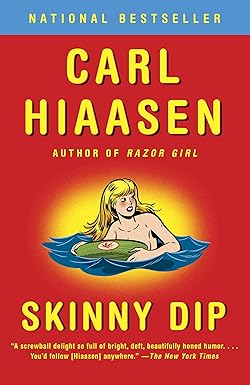
The Push Overboard That Sets the Tone
Carl Hiaasen starts Skinny Dip with a shove. Not a metaphorical nudge, not a literary throat-clearing—an actual shove over the rail of a cruise ship cutting through warm Florida water, the splash of betrayal echoing into a night so humid it feels like a character. Joey Perrone, our wronged wife and soon-to-be master of controlled vengeance, is pitched into the dark by her husband Chaz, a marine biologist with a gift for grift and a deficit for conscience. She should die: that’s the logic of physics and pulp. But Hiaasen writes Florida like Florida writes itself—outlandish, buoyant, and salt-stung—so Joey lives, clinging to a bale of weed and the stubborn idea that survival can be a genre all its own. In a few pages, the novel establishes its metabolism: fast, funny, ecological, furious. It’s a caper with a conscience and a comedy with a pointy bite, the kind of story where the tide keeps returning, bringing back everything you thought had sunk forever. The Washington Post
Table of Contents
Florida, as Usual, Refuses to Behave
Hiaasen’s Florida is not backdrop; it’s the engine, the appetite, the punchline nobody wants to claim. The Everglades don’t simply “appear” in Skinny Dip; they preside. Long before Joey begins her exquisitely petty campaign to dismantle her husband’s sanity, the swamp has already been dismantled—ditched, diked, and politically diced—until it’s a landscape where bad money and worse governance have done to water what Chaz tries to do to his wife: make it disappear and pretend nothing happened. The satire lands because it’s accurate enough to sting; even Michael Dirda, in a rave that understands the book’s breezy surface, notes that Hiaasen’s comedy rides on a current of environmental anger. You come for the caper and stay for the radiating sense that the place itself is being had, and Hiaasen is determined to make the conmen look silly before he makes them look small. The Washington Post
On the Compass: Place as a Protagonist
Readers at The Literary Compass know we’re pushovers for novels where landscape has agency. Our recent meditation on place-driven narratives in contemporary fiction leans on this idea: that setting can argue back, nudge characters toward truth, or throw them into the muck when they lie to themselves. Florida does all three here. For more terrain-obsessed unpacking, see our essay on topographies that boss their plots around in “When the Setting Wins the Scene”.
Joey Perrone: Survivor, Trickster, Ethicist in Disguise
Joey isn’t an avenging angel so much as an inventive Auditor of Bad Behavior, with a ledger and a flair for theatrical accounting. The pleasure of Skinny Dip is that Hiaasen makes her both canny and kind—there’s a gentleness in how she decides to let Chaz unravel at his own pace, to tweak circumstances just enough to make his paranoia do the heavy lifting. The line between prank and justice is thin in this book, and Joey walks it in bare feet, drawing blood when she must, slipping away when she should. When she teams up with Mick Stranahan, an ex-investigator who understands how to turn a crook’s ego into a confession, the novel finds its groove: a partnership built on unshowy competence, mutual charm, and a shared belief that Florida’s villains should be defeated with style. Dirda spots it—the caper structure keeps the dread low and the comeuppances high; you read to see precisely how the nasties will be humiliated. The Washington Post
Continuity, for the Devotees
Hiaasen’s world is wonderfully leaky—characters spill from one novel to another like tidewater through mangroves. Mick Stranahan returns here after Skin Tight, bringing his don’t-call-it-isolation island life and his lethal deadpan. In a later beat, the hermit who rescues a wounded woman in the dark swamp carries the unmistakable scent of Skink (Clinton Tyree), the novelist’s once-and-future eco-avenger, a continuity nod that functions like a fan’s wink without alienating first-timers. Hiaasen’s saga can be read anywhere you dip into it, but the water is thick with earlier currents if you’ve swum here before. Wikipedia+1
Chaz Perrone: The Biologist Who Doesn’t Believe in Evidence
Hiaasen’s villains are always a few degrees past plausible, and that’s the trick: they’re recognizable enough to indict a system yet grotesque enough to bag the laughs. Chaz is a perfect specimen. He draws a state paycheck to test Everglades water for pollutants and another from Red Hammernut, an agribusiness prince who needs the numbers massaged until the swamp looks clean as a dentist’s sink. Chaz fakes science, pockets cash, and confuses libido for identity; the only principle he honors is the path of least resistance. One of Dirda’s funniest observations pins Chaz’s professional incompetence to his domestic frauds: any “marine biologist” who doesn’t know the direction of the Gulf Stream isn’t just a crook—he’s a joke Hiaasen intends to run into the ground and bury. The Washington Post
The Long Shadow of Real-World Water
Pull the camera back and Skinny Dip isn’t just slapstick with lily pads; it’s engaged in a conversation with Florida’s hydrological history. Michael Grunwald’s reporting on the Everglades—the drainage, the agriculture, the politics, the $8-billion rescue plan—offers a counterpoint to Hiaasen’s artful simplifications. Grunwald argues that household water demands and municipal growth pose threats as potent as farm runoff, and that blaming “the heavy” alone is rhetorically satisfying but strategically incomplete. Hiaasen knows this, too; he isn’t pretending to be a policy manual. He’s writing a fable about complicity and consequence. Grunwald’s prose puts the facts on record; Hiaasen’s plot puts the anxiety in your gut. They meet mid-current, one insisting on complexity, the other insisting on outrage. The New RepublicPublishersWeekly.comGoodreads
Red Hammernut: Subsidy King, Fertilizer Baron, American Archetype
If Chaz is moral dry rot in a lab coat, Red Hammernut is the plantation mind in a polo shirt: a man who believes himself the hero of his own subsidy thriller. In one of the novel’s most scabrous descriptive passages—excerpted approvingly in the Washington Post review—Hiaasen inventories Red’s bribery outlays like a farmer checking irrigation lines: pay the politician, pay the girl, pay the yacht, pay the luck. The comedy works because it reads like a ledger of real practices, exaggerated only in concentration. Hiaasen’s point isn’t subtle: the same hand that sprinkles fertilizer on the fields sprinkles money into the body politic, and the runoff from both is everybody’s problem. The Washington Post
Satire with Teeth, But Also Triage
Kirkus called Skinny Dip “bitingly satirical, sublimely zany, and deeply satisfying”—a string of adjectives that could double as an Everglades weather report. What distinguishes Hiaasen here is his management of tone. He’s mean exactly where he needs to be and humane everywhere else. A writer less in love with Florida would grind his axe until the sparks outshine the story; Hiaasen lets the story carry the charge. His language has that newspaper-columnist clarity—cutting when it must, always legible—that reminds you he’s spent decades at a desk staring down the day’s nonsense and figuring out how to make people care about it. Kirkus Reviews
Tool and Maureen: Grotesque, Then Gentle
Hiaasen’s henchmen tend to arrive wearing their own punchlines. Earl Edward “Tool” O’Toole is an illiterate enforcer who steals fentanyl patches off nursing home patients; in a grim talent show of moral nadirs, that trick is top-tier. But Skinny Dip refuses to leave anyone fully monstrous. When Tool befriends Maureen, a terminally ill woman with a spine of steel and a tongue like a whip, he begins to shed the armor he doesn’t understand he’s wearing. Hiaasen never excuses Tool, but he allows surprise: rough men can make soft choices, and the swamp is big enough for unexpected tenderness. It’s a structural kindness of the book, the way comedy opens a seam for grace. Even Kirkus, in its compact pre-publication praise, takes time to point at Tool’s strange bloom. Kirkus Reviews
Detective Karl Rolvaag and the Slow Pleasure of Suspicion
Rolvaag—the Minnesota exile counting the days until he can stop sweating—provides the procedural spine to Joey’s improvised theater. He’s not flashy; he’s patient. In Dirda’s lively summary, Rolvaag notices exactly what a caper antagonist fails to notice: small indecencies that scale to crimes. The comic beats (pet pythons; a suspect who can’t keep aquarium fish alive) sharpen rather than soften the investigative line. Hiaasen’s particular genius is to keep Rolvaag’s competence funny without making competence itself a joke. In a comic novel, this is a neat trick: the law can be both laughable and necessary, and Rolvaag embodies that paradox with a dry wipe of the brow. The Washington Post
Stiltsville, Biscayne Bay, and the Geography of Comeuppance
Hiaasen stages scenes in places that feel both implausible and documentary: the stilt houses freckling Biscayne Bay like an architectural dare; the canals and hammocks where light gets swallowed whole; the condo sprawl that feels like an invasive species. When storms roll in—and they do, with satisfying cinematic timing—the book enters that pleasurable register where weather participates in justice. The bay becomes a court; the stilts, a witness stand. Hiaasen, born to this exact kind of staging, understands Florida’s gift for symbolic literalism: a man trying to fake numbers in a state famous for “hanging chads” deserves to be chased across a platform home built to outwit the water. The caper wants a stage; the state supplies a perfect one. (Wisconsin Public Radio’s 2005 reading series write-up catches the novel’s storm-lit romp vibe in miniature.) WPR
On the Compass: Our Ongoing Florida Shelf
We’ve been building a Florida-fiction shelf that pairs the neon of crime satire with the subtropics’ darker hues. If Hiaasen is the patron saint of the Sunshine State send-up, we’ve argued that his spiritual cousins include the humane absurdists who turn place into pressure—see our growing dossier on American noir mapped by weather systems and our long read on comic crime that smells like tidewater.
How Hiaasen Tunes the Joke
One reason Skinny Dip works as well as it does is the way Hiaasen calibrates humiliation. His bad men don’t merely lose; they lose specifically, in ways that echo the stupidities they perform. To fake an environmental test is to misunderstand the patience of water; to cheat, bribe, dump, and sneer is to forget that ecosystems store grievance as slowly as they store toxins. Hiaasen answers with symmetrical embarrassments—sexual flops, public exposures, comic derangements—that feel both pointed and earned. In review after review, critics note the caper’s clockwork (Kirkus flags its zany satisfaction; the Post ties its pleasures to classic comic-crime beats). To borrow Dirda’s transatlantic metaphor, some endings read like Waugh plotting his nastier little parties, only with more mangroves and fewer monocles. Kirkus ReviewsThe Washington Post
Comic Lineage, with a Florida Twist
Hiaasen’s forebears are easy to spot—Donald Westlake’s capers, Elmore Leonard’s dialogue, even the brisk sting of newspaper humor columns—and yet the synthesis is idiosyncratically his. He’s a Miami Herald lifer with the instincts of a beat reporter and the timing of a stage comic, which means he trusts the facts of a place to be funny before he starts gilding them. The Everglades restoration debates, the sugar politics, the development schemes: these are not subplots, they’re the groundwater the plot drinks. Hiaasen doesn’t write “issue novels.” He writes Florida, which is the issue. (For background texture on the region’s political ecology, Grunwald’s The Swamp remains indispensable context; Hiaasen the columnist and Hiaasen the satirist converse across your reading list.) PublishersWeekly.com
Joey and Mick: Chemistry that Refuses to Be Smug
Romantic subplots in capers are famous for two things: banter and bad luck. Joey and Mick supply the first in spades and refuse the second, and the book is better for it. Their flirtation is honest about age, appetite, and competence—grown-ups meeting each other at the exact speed of their trauma and their charm. Dirda’s review leans into this, painting a portrait of a pairing that feels like relief as much as desire. In a novel where men abuse power as a matter of habit, it matters that one man—still flawed, still a wiseacre—uses his skill to make a woman safer, not smaller. Hiaasen isn’t sentimental about gender (his rogues’ gallery of women includes sweethearts and scammers), but he’s precise about the uses of care. The Washington Post
The Vengeance Ethic (and Its Limits)
Joey doesn’t pull a trigger. The book teases you with the possibility—takes you right to the brink of vigilante symmetry—and then trusts humiliation to do its work. The choice scans morally and stylistically: Skinny Dip isn’t a revenge fantasy so much as a competence fantasy, the satisfaction of seeing deceit undone by a person who refuses to become what she hates. It’s a soft stance in a hard comic world, and one reason readers talk about the novel as “deeply satisfying” rather than merely “funny.” Kirkus Reviews
The Scene-Stealer Named Skink
There’s a joy specific to the moment a beloved recurring character wanders into a book where you didn’t strictly need him. Skink is that joy. A one-eyed former governor turned swamp hermit and eco-vigilante, he surfaces in Skinny Dip more like a current than a cameo—rescuing, tending, nudging fate toward fairness. For long-time Hiaasen readers, his presence confirms the series-wide project: the swamp has its guardian, not mystical but mythic, a man whose politics have been boiled down to three truths—don’t wreck the water, don’t wreck the critters, don’t wreck your soul. (Hiaasen’s continuity breadcrumbs make the appearance explicit for those tracking his saga across decades.) Wikipedia
On the Compass: Recurring-Character Ecologies
We’ve argued before that serial protagonists can function as ethical barometers for their regions. If that idea intrigues you, dive into our running feature on recurring characters as civic myths, where Skink shares a long table with everyone from V. I. Warshawski to Dave Robicheaux.
How the Book Reads Now
Time has a way of sifting satire. Some jokes calcify; others sharpen. Reread in the mid-2020s, Skinny Dip feels startlingly spry. The environmental throughline is, if anything, more topical; the corruption jokes depress only in the way the very idea of “timelessness” can be depressing. The caper moves like a skiff before a storm—light, quick, weirdly stable. And while the plot’s scaffolding (fake blackmail, staged hauntings, screwball-dark entrances and exits) could wobble in lesser hands, Hiaasen keeps the boards tight. There are moments where the zany threatens to overgrow the narrative like kudzu, and even Dirda wonders if a gag or two over-repeats. But the ratio holds: for every farcical hide-under-the-bed beat, there’s a generous human beat to ballast it. The Washington Post
The Everglades as a Moral Classroom
What does the swamp teach? That systems are slow. That damage accumulates invisibly until it doesn’t. That everything is downstream of something cruel or careless—cattails of policy, gators of money, storms of indifferent convenience. Hiaasen’s comedic architecture forces readers into a paradox: you are laughing at men who are poisoning water. The discomfort is the point. Florida humor has always been a coping strategy with teeth; Skinny Dip bites hardest when it makes you giggle at the exact moment you notice your shoes are wet.
The Grunwald Interlocution
Pairing the novel with Grunwald’s The Swamp (and the decades of public argument around Everglades restoration) gives the reading experience a dialectical richness. Hiaasen assigns the harm to villains because novels need villains; policy assigns harm to gradients of human demand because reality often works in gradients. Both truths can be held in one head. The trick is not to let the gradients exonerate the bad actor or let the bad actor eclipse the gradients. If the satire turns the faucet of outrage, history helps you plumb the pipes. PublishersWeekly.com
The Caper’s Contract with the Reader
Caper fiction, done right, is a contract: the author promises inventiveness, escalation, a moral center that may be flexible but isn’t hollow, and an ending where the universe rights itself with panache. Skinny Dip signs in big ink. One strand braids Joey’s mind games; another follows the methodical detective; a third tracks the money. By the time all three pull taut at Stiltsville in the storm, you’re not asking if justice will be done but how joyfully it will be done. That confidence—cultivated by clean setups and kept by cleaner payoffs—earns the novel its reputation not just as “classic Hiaasen” but as a highlight even among fans who know his canon’s rhythms by heart. (Kirkus’s capsule verdict—“get it”—lands like a stamp you can still hear.) Kirkus Reviews
The Afterlife on Screen (and Why It Makes Sense)
Hiaasen adaptations have a way of finding studios when the zeitgeist warms to Florida absurdism, and Skinny Dip’s combination of brash crime and swampy conscience makes it catnip in a TV moment that loves prestige capers with moral spice. Development whispers have circulated for years, but in March 2025, industry reporting tied a potential Max series to a trio of names with a track record for populist-smart genre: Bill Lawrence, Adam Horowitz, and Edward Kitsis. If the project clears the usual development thickets, it could inherit both the visual bounty of the setting and the tonal ambidexterity that makes the book tick—giddiness and gravity on the same screen. Yahoo NewsAOLScreen Rant
On the Compass: Book-to-Screen
We keep a running, occasionally skeptical, column about comic-crime adaptations and what gets lost when prose becomes camera movement. If Skinny Dip lands a full series order, expect a deep dive in “Florida, Framed: Filming the Unfilmable Swamp”.
A Note on Reader Reception (and Why It Matters Less Than You Think)
Goodreads star tallies and radio-serial selections don’t determine a novel’s staying power, but they do sketch the first ring of the book’s social life. Skinny Dip has lived a robust one—book club grins in the early aughts, radio readings that turned commutes into madcap swamp tours, “favorite Hiaasen” declarations from readers who measure his books by the size of the grin they leave on the last page. None of that is data in the peer-review sense; all of it is evidence in the human sense. A comic novel that still feels newly rude two decades on is doing something metabolically right. WPRGoodreads
Why Skinny Dip Endures
Because it’s angry without being joyless. Because it understands that corruption is a systems problem and still finds the human faces worth mocking. Because it believes competence is sexy. Because it treats Florida like an unruly aunt who drinks too much at the reunion and then pays the caterer in cash with a wink. Because Joey Perrone’s blend of mercy and mischief feels like a survival ethic you could live by—do the least harm necessary to avert the most harm possible, laugh when you can, swim when you must. Because it’s a book in which a woman thrown to the dark by a man who never earned her learns, in almost every chapter, that the water—dangerous, fickle, alive—will carry the clever farther than it will carry the cruel.
And Because the Sentences Smile
Dirda’s review quotes are a reminder that you can trace an author’s love for his place by the throwaway lines. Hiaasen writes Florida’s venality with verve, but he also writes its day-to-day silliness with affection—the bad handwriting of a panicking fraud; the magazine used as a shield in a waiting room; the wry music cues of a middle-aged flirtation. These are pleasures for their own sake, small craft joys in a novel with big ethical bones. The Washington Post
Read it Next To…
If your shelves already sag with Florida fiction, Skinny Dip will slide in like a sunburnt friend. If you’re new to Hiaasen, it’s a great starting point: brisk, outrageous, legible in its anger, and somehow—miracle of tone—gentle where it counts. It’s also a lively companion to the essays and reporting that make its satire resonate. Set it next to your copy of The Swamp, and let fiction and fact spar over dinner. (We’ve written about that kind of pairing—the dialectic between novels and their nonfiction shadows—over at “When Facts and Fictions Share a Table”.) PublishersWeekly.com
Final Lap: What the Caper Says About Us
The caper’s secret is that it’s a moral fable in a Hawaiian shirt. We watch outrageous schemes go sideways so we can feel, for a moment, that justice is not only possible but delicious. In Skinny Dip, justice tastes like brackish water and humble pie. Joey doesn’t break; she bends the narrative toward an ending that refuses to make murder look clean. Chaz doesn’t learn; he merely reveals. Red doesn’t repent; he embodies. Karl doesn’t swagger; he persists. Tool doesn’t deserve grace; he receives some anyway. Mick doesn’t save the day; he helps Joey save her own. Florida doesn’t heal; it endures and insists.
That insistence—on endurance, on laughter that bites, on ecosystems as moral teachers—keeps Hiaasen’s novel tasked and tuned. He knows that satire can turn sour if it loses its sense of play, and that play can feel irresponsible if it forgets who’s paying the hidden costs. Skinny Dip walks that swampy board between hilarity and hazard and dares you to fall in. It’s the rare comic thriller that leaves you lighter and heavier at once: lighter from the relief of seeing fools unmasked, heavier from the knowledge that the water will still be there tomorrow, carrying our runoff and our stories out to sea.
Editor’s note for returning Compass readers: If you’re mapping your way through our Florida sequence, you might pair this essay with our longform on environmental noir “Silt, Salt, and Satire”, and our forthcoming deep dive on Hiaasen’s recurring cast “Skink and Company: The Ecology of a Shared Universe”. For a different but spiritually adjacent caper that treats place as accomplice, our take on Mr. Penumbra’s 24-Hour Bookstore leans into urban whimsy rather than subtropical farce, but the craft questions rhyme: how much plot can a style carry, and how much style can a place absorb? Find that conversation here: “Neon Dust and Back-Room Books”.