
The Forest as Home and Cage
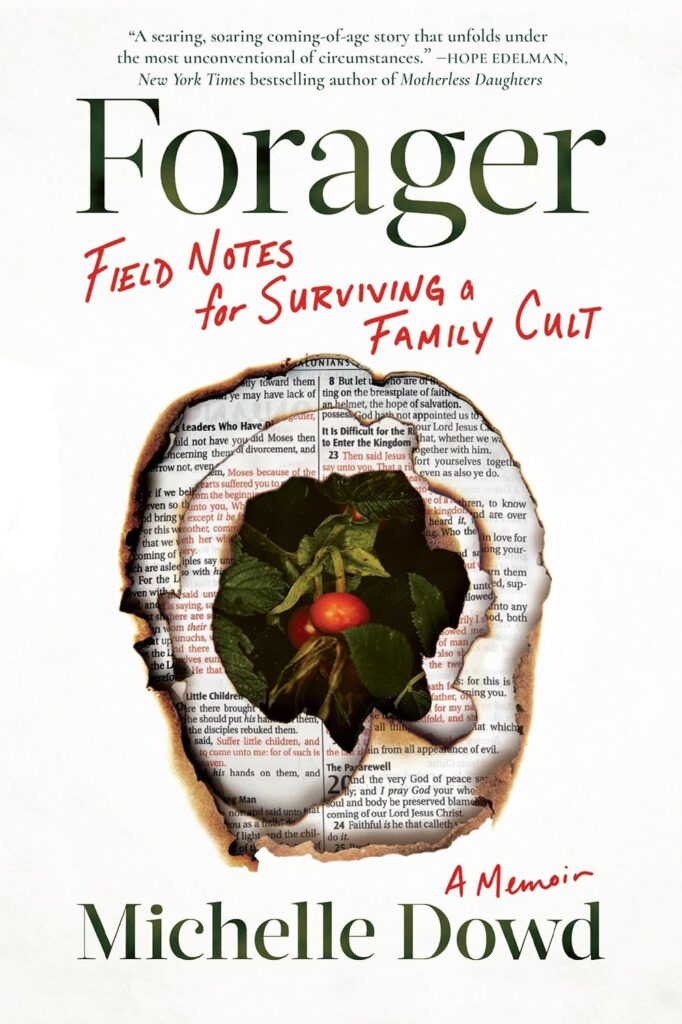
Michelle Dowd begins Forager: Field Notes for Surviving a Family Cult with a voice that is both immediate and unflinching. There is no warm prelude, no gentle easing into the world she was born into; instead, we are dropped into the middle of the Angeles National Forest, where the air is thin and cold, the ground is littered with pine needles, and survival is not just a matter of keeping warm — it is the measure of your worth. Her grandfather founded a secluded doomsday cult known simply as the Field, and for Michelle, childhood meant a life on permanent watch, preparing for an apocalypse that always seemed to be arriving tomorrow.
The land itself becomes an omnipresent character in the memoir. Its ridgelines and wild plants are both sanctuary and snare, places where a child could disappear into moments of quiet awe and where those same moments could be snatched away by the rigid discipline of the cult. This duality — the wilderness as a place of freedom and the wilderness as a perimeter fence — is one of the central tensions that animates the book. It’s a theme that The Literary Compass has explored in other nature-infused memoirs, but here it feels sharper, more primal, because nature is not a retreat for Dowd; it is the arena in which she was trained to fight for her life.
Lessons in Foraging and Obedience
From a young age, Dowd was taught to identify wild edibles, to purify water, to dress wounds, and to sleep without shelter in freezing temperatures. These lessons were not framed as charming skills or adventurous hobbies; they were demands, obligations tethered to a belief system that viewed the outside world as irredeemably corrupt. Comfort was a weakness. Hunger was an opportunity to strengthen your spirit.
What makes Forager remarkable is how Dowd writes these skills into her memoir as chapter openings — each section begins with a field note on a plant, mushroom, or tree, detailing its appearance, uses, and dangers. These entries are both practical survival tips and emotional signposts. The reader quickly understands that for Michelle, the act of naming a plant was a way of naming herself. Each botanical description is followed by a memory — a moment when knowledge of wild mustard or acorns or pine sap made the difference between sustenance and emptiness.
This structure allows the memoir to oscillate between a how-to manual and a coming-of-age story, blending the tangible and the intangible in a way few memoirs manage. In doing so, it recalls the narrative layering of Braiding Sweetgrass, though Dowd’s tone is sharper, edged with the survivalist’s refusal to romanticize hardship.
The Weight of Patriarchy
The cult’s gender hierarchy was non-negotiable: men issued orders, women obeyed, girls learned to keep their heads down. Dowd writes about her grandfather with a mix of clarity and restraint. He is not portrayed as a cartoon villain; rather, he is depicted with the cool precision of someone sketching a plant — noting its size, its thorns, its toxic parts. This control of tone makes the memoir’s depictions of patriarchal dominance all the more chilling.
Her mother, too, is an indelible figure in the narrative — a woman who repeated the survival mantras “Don’t be afraid. Be competent. Survive fear,” but who could not fully protect her daughter from the system she had already accepted. The intergenerational transmission of both strength and submission is part of what gives Forager its depth. We see how resilience is taught, but also how that resilience can be twisted to uphold the very structures it could dismantle.
Survival as Identity
One of the memoir’s quiet revelations is that survival skills, once learned, are hard to unlearn. When Dowd begins to imagine life beyond the Field, she realizes she carries with her the discipline, watchfulness, and resourcefulness instilled by the cult. These traits are not discarded; they are repurposed. She writes about the paradox of liberation: to escape the forest, she must use the skills the forest gave her.
This truth resonates with anyone who has left a controlling environment — the realization that the very tools of your oppression can become the instruments of your freedom. In Forager, this transformation is slow and patient, like the growth of the plants Dowd catalogs. There is no single moment of cinematic defiance; instead, there is a series of quiet refusals, private awakenings, and strategic retreats.
A Child’s Perspective Without Hindsight
One of the most difficult feats in memoir writing is to inhabit the voice of one’s younger self without drowning it in the commentary of the older, wiser narrator. Dowd accomplishes this with striking discipline. She does not tell us what to think about her past; she simply shows us what happened, moment by moment, allowing the reader to draw conclusions. This narrative restraint gives Forager its authenticity.
There are passages where the reader might expect an outburst of anger or judgment, but instead finds a botanical note or an understated description of a small act — folding clothes scavenged from donations, cataloging plants for winter storage, slipping a forbidden book under her bed. The absence of overt moralizing does not diminish the emotional impact; it heightens it.
Education as the Exit Strategy
Dowd’s escape from the Field is gradual, catalyzed by education. Even when books were scarce and censored, she found ways to read, to ask questions, to notice contradictions in the teachings she had been given. These moments of intellectual defiance are subtle, but they are revolutionary in their own right.
When illness — an autoimmune condition — forces her into contact with the outside world, she begins to imagine a life beyond the mountain. The survivalist skills that once tethered her to the Field become the foundation for a different kind of survival: navigating college applications, finding work, building a life that is not dictated by her grandfather’s apocalyptic vision.
The Memoir in Conversation with Others
For readers of The Literary Compass, Forager sits comfortably alongside memoirs like Educated and The Glass Castle, both of which explore the tension between loyalty to family and the necessity of breaking away. But Dowd’s work distinguishes itself with its integration of ecological knowledge, creating a second storyline — the story of a girl becoming fluent in the language of the land even as she struggles to free herself from the language of the cult.
Where Educated often situates survival in terms of intellectual achievement, and The Glass Castle uses wit to disarm the brutality of poverty, Forager roots survival in the physical — in the identification of plants, the gathering of food, the endurance of weather. This grounding makes it a unique contribution to the canon of escape narratives.
The Psychological Aftermath
While Forager is not a therapeutic memoir in the traditional sense, it does not ignore the psychological cost of survival. Dowd writes about the lingering sense of vigilance, the difficulty of trusting comfort, the way scarcity shapes one’s relationship to abundance. These reflections are woven into the narrative without breaking its flow, and they invite readers to consider the long tail of trauma.
Her presence in recent interviews and discussions reinforces this theme. She speaks not only about the cult itself, but about the ongoing process of reclaiming her body, her health, and her sense of belonging in the world. It is a reminder that escape is not the end of the story; it is the beginning of a different kind of endurance.
Conclusion: The Field Notes We Carry
By the time the memoir closes, the reader has learned not only about Michelle Dowd’s childhood, but also about wild mustard, miner’s lettuce, acorns, and the quiet resilience of plants that thrive in poor soil. These details are not decorative — they are the essence of the book’s metaphor. We survive by noticing, by naming, by remembering what can keep us alive when nothing else can.
For readers drawn to the intersection of survival, ecology, and personal transformation, Forager: Field Notes for Surviving a Family Cult is a work that lingers. It is a testament to how knowledge of the natural world can become both a lifeline and a compass, pointing the way out of the wilderness — whether that wilderness is made of trees or of people.